
AI reasoning presents the opportunity to accelerate the time from data to optimal action in the process industries.
Author: Jagadish Gattu, CEO at UptimeAI
This article first appeared on Jagadish Gattu’s LinkedIn page.
On a recent call with LNS Research we were introduced to the term “Decision Latency”. The deeper we dug into their use of the term, the more we felt it captures the message of what we are doing at UptimeAI –> providing expert-like recommendations rather than simply alerts or insights to eliminate the rate limiting step in the data to action cycle.
Criticality of “Real-time” in Real-time Decision Making
LNS Research COO Council member Michael Carroll recently published a narrative highlighting the negative impact of decision latency on both momentum and margin. In the heavy process industries, the most optimal way to run right now may not be the same 1 month from now, 1 day from now, or even 1 hour from now. Insights are only as useful as their ability to meaningfully impact the business. Acting on stale insights not only fails to capture the full potential value but can even negatively impact operations when process dynamics evolve to favor different operating strategies.
Refineries, chemical plants, and power plants are constantly balancing hundreds of variables—from feed quality and equipment condition to weather, ambient temperature, and load demand. These dynamics shift minute-to-minute, sometimes in nonlinear ways. Operators and engineers spend most of their time optimizing for yesterday’s conditions, which could come at the expense of tomorrow’s efficiency.
Abundance of Insights Exaggerates the Expert Bottleneck
To capitalize on insights, they need to be interpreted and actioned in real-time (rather than after the fact). Historically, this has relied on human judgement, cross-coordination, and collaboration across teams. By the time insights are discussed, validated, and acted upon, the process has often already changed, and the window of opportunity has passed. This means the quantity and expertise level of site employees will directly limit the ability to achieve optimal performance at scale.
Closing the Decision Latency Gap
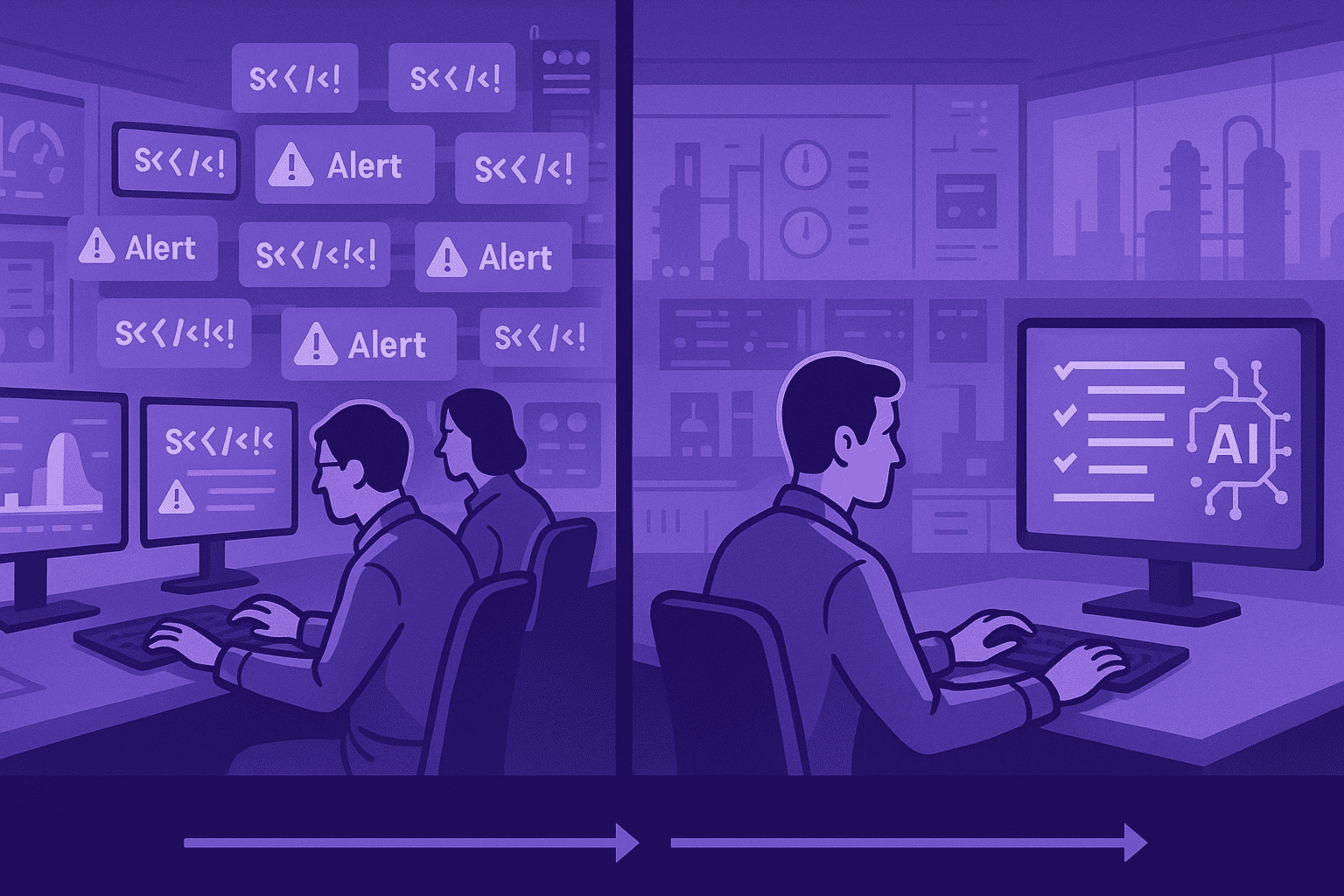
The bulk of time and effort for plant SMEs is spent interpreting and validating alerts,diagnosing root cause, and developing an action plan to present to operations or maintenance teams. We founded UptimeAI to address this issue.
UptimeAI’s approach uses expertise built into the solution in the form of 1000+ asset-specific failure modes combined with an expert-like reasoning engine to provide
real-time, context-aware recommendations. By attacking this rate limiting step in the decision-making process, we can meaningfully shrink time to action.
Our reasoning engine simulates the logical thought process of a plant expert as they think through cause and effect. It leverages plant history, cross-functional data sources, and a system-level (rather than asset-level) view of the process. Instead of telling an operator “Compressor efficiency is dropping,” it explains why it’s happening, how it’s impacting other units, and what action will yield the greatest improvement right now.
Across refineries, chemical facilities, and power plants, this shift from insight investigation latency to recommendation immediacy is proving measurable gains in throughput, energy efficiency, and reliability. Decision latency becomes a solvable problem when the same expertise that has historically limited scale can be codified and run at the speed of software.
For a first-hand view of what it’s like to defeat real-time decision latency, get a demo.