By Vinay Birthare, Cement Industry Senior Consultant at UptimeAI
The cement industry isn’t alone in the expertise crisis facing the whole of the manufacturing industry, but it’s been hit harder than most. For decades, plants relied on deep tribal knowledge of operators and engineers with 10, 20, 30+ years of experience who knew every sound, vibration, and smell in the plant. Mass retirements, rapid turnover, and fierce competition for engineering talent have made employees with decades of experience the outliers, while small single digit tenures have become the standard.
The numbers shared by our cement industry customers confirm the industry trends: in 2002, more than 85% of employees of a major Midwest producer had been with the plant for over 10 years. Last year, more than 90% had been there less than five. The knowledge base that was once the backbone of safe, reliable operations disappeared almost overnight.
Another factor at play is the pace at which the industry has historically adopted new technology. Compared to the relatively digitally savvy oil and gas or chemical industries, cement has been slower to embrace technology-aided new ways of working. As one leader at a top-10 U.S. cement producer put it, “In the cement industry, we’ve historically been behind on innovations… it’s a very old-school industry.”
The industry legacy at odds with today’s reality
The impact of the experience gap is felt daily in cement operations. Remaining experience is stretched thin making troubleshooting efforts longer and breakdowns more frequent. The historical reliance on employee experience for troubleshooting contributed to technology adoption not keeping pace… because it didn’t need to. One of our customers told us “We used to have people walk around the plant that would hear a certain sound and know it’s a belt slipping or a bearing going out.”
With dramatically less experience, the traditional toolset is no longer sufficient to keep the plant running reliably. As one customer told us, “The control system alarm doesn’t capture all of the early indications, and by the time an alarm appears, the problem has already escalated.” With an increasing number of issues and fewer experts to interpret them, cement companies are realizing they are either going to have to adapt or going to be left behind.
Technology innovation could be the cure for the expertise crisis
These plants needed a way to bridge the widening gap between inexperienced operators, evolving equipment behavior, and the process expertise that was no longer a constant presence inside the control room. They needed to replicate the knowledge, experiences, context, and thought processes of the folks leaving. One of the key capabilities, and one that’s been the hardest to mimic until recently, is the expert’s ability to reason across siloed functions, data sources, and teams.
Technology that can detect issues, diagnose root causes, and recommend tangible actions to go do is the missing link that bridges the experience gap. An experienced engineer at a major cement facility spent years on rotation, always available to the control room to interpret and react to issues detected. He described their transition to UptimeAI: “It was like our perfect employee. It was like having myself or another process expert in the control room 24 hours a day pinpointing things before they happen instead of notifying you after.”
Quick results are convincing historically late adopters
For one customer, the first three months of engagement have hinted at exciting future potential. Here are some of ways that AI has taken an expert-like approach to detecting, diagnosing, and mitigating reliability issues.
- Avoided $1M kiln-drive bearing failure: UptimeAI caught a kiln-drive bearing temperature anomaly weeks before it might have hit the OEM-recommended alarm point. The team slowed the drive, kept the equipment alive, and made it safely to a planned maintenance window.
- Recovered 25% production on a finish mill: A dust collector running with >50% broken air pipes and >25% plugged was flagged by UptimeAI’s correlation-based analysis. The catch prevented months of potential reduced rate operations, and the fix at the next opportune downtime prevented an environmental dusting incident and restored lost throughput.
- Avoided $2M kiln outage from preheater cyclone plugging: UptimeAI saw a deviation in cyclone aeration ring specific pressure (an UptimeAI calculation designed to detect cyclone bottom pressure decreases with no change in kiln feed). The alert recommended the site to check the bottom of the cyclone for plugging, which was confirmed. The site team cleared the plug online avoiding a major breakdown costing $180k in maintenance with up to $2M in kiln downtime.
- Prevented a hazardous coke-bin fire: UptimeAI caught a smoldering condition 40°C before the alarm threshold would have been triggered. The intervention avoided destruction of a $75k Coriolis meter and a four-day kiln outage for repairs, worth more than $2M.
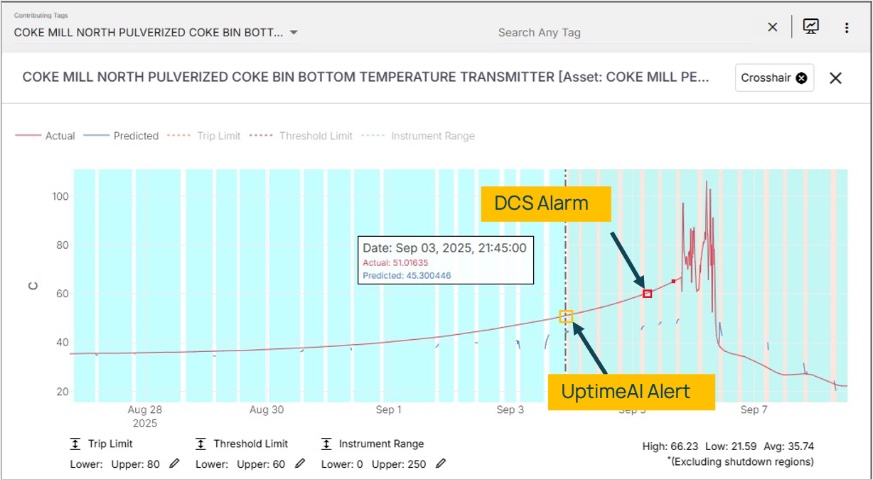
Figure. UptimeAI alert issued more than a day before the DCS alarm limit was reached. These plant reliability catches are part of a longer list of avoided reliability incidents that have more than covered the company’s required hurdle rate for software investment. They’re expecting a high double-digit ROI in the first full-year lookback.
Benefits beyond the plant fence
Talent attraction and retention are often directly linked to an employee’s satisfaction both on and off the job. In addition to reliability and throughput improvements, operators and engineers are feeling the impact of reduced stress and uncertainty in their day-to-day. “It’s really been helping us when we’re on call… they can start the kiln back up without having to call someone,” one leader said. The result is fewer late-night emergencies, fewer missed family events, and more predictable operations. “If you can get it to where you’re not making someone miss their kid’s birthday or baseball game, that’s a big impact.”
The cement industry’s reputation for old-school operations slow to adopt technology is lifting. The expertise crisis served as the catalyst for technology innovation, restoring the industry’s ability to run reliably and confidently without reliance on the individual human expert.